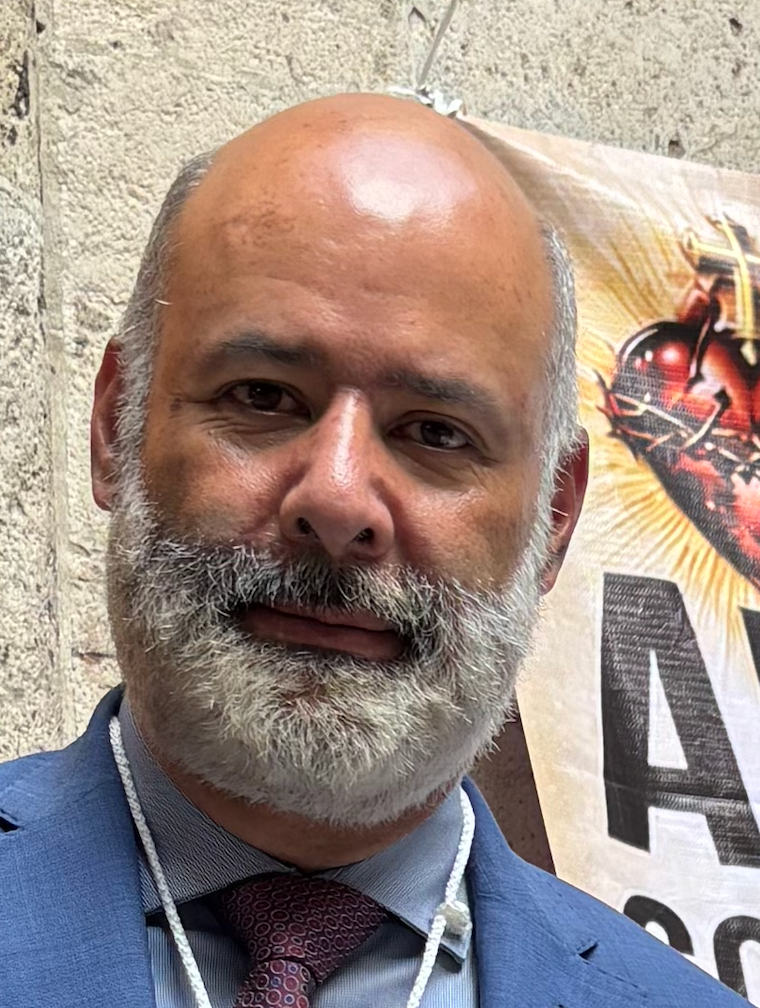
Dedicated to Dr. José Mauro González-Luna Mendoza, friend and leading expert on the life of Blessed Anacleto.
Introduction
The life of Blessed Anacleto González Flores, patron of the laity of Mexico and a source of inspiration for many others, raises a question that goes far beyond the Cristero movement: how can the Church form Catholic laypeople capable of living the Christian life seriously, assuming apostolic responsibility, and remaining faithful when the institutions that first formed them weaken or disappear?
The Catholic world in which Anacleto was formed offers an important example. After studying in the seminary, he moved to Guadalajara, where his continuing Catholic formation did not come from isolated spheres. In early twentieth-century Guadalajara, parish life, Marian associations, Jesuit and Franciscan spirituality, intellectual formation, Eucharistic devotion, Catholic friendships, and organized social action existed within a relatively compact urban environment. These were distinct realities, but they belonged to the same Catholic world and could reinforce one another in their formative work.
This environment suggests three conditions for a serious ecology of Catholic formation: comprehensiveness, proximity, and coherence. Formation must encompass the whole person; its different elements must be close enough to become part of ordinary life; and the institutions and communities involved must share a sufficiently common vision of Christian life to reinforce rather than contradict one another.
Anacleto’s life also reveals a paradox that is especially important today. The Church of earlier times had many more priests and could appear more clerical, yet precisely this abundance of clergy allowed priests to devote considerable time to the personal formation of laypeople who, in time, could act without constant clerical supervision. A Church with fewer priests can produce the opposite result, because the remaining priest becomes so indispensable to sacramental life that he has less time to form the laity and can become the bottleneck through which almost every serious Catholic initiative ultimately has to pass.
Anacleto’s Guadalajara thus offers a model: a network of parishes, associations, schools, spiritual traditions, study groups, priests, and laypeople that, while fulfilling different functions, contributed to comprehensive formation, shared a coherent Catholic vision, and existed in sufficient physical proximity to form part of the same ordinary life.
Anacleto’s Guadalajara
Anacleto lived within a relatively compact Catholic world. San José de Gracia offered much more than a place for Mass. The Marian Congregation associated with the church belonged to a tradition of disciplined lay formation, while Nocturnal Adoration added another kind of formation through extended Eucharistic vigils. Nocturnal Adoration formed people in sacrifice not only through the mind but also through the body, because its members gave up sleep and comfort to spend the night, in shifts, before the Blessed Sacrament.
A short distance away stood the Instituto San José, directed by the Jesuits and one of Guadalajara’s centers for the intellectual and spiritual formation of Catholic youth. Among its students was Efraín González Luna, who arrived in Guadalajara while still a child, when his father, Lic. Mauro H. González Álvarez, moved there with his wife, Rosario Luna Michel, and their children in 1911. The family’s relationship with Anacleto also had a personal dimension: according to the testimony of their descendants, Anacleto worked as a law clerk in Mauro H. González’s office. Years later, Anacleto invited Efraín to join the Círculo León XIII and to participate in the founding of the ACJM in Guadalajara in 1916. Efraín’s case thus illustrates how formation received in a Jesuit institution could later continue through personal networks of study and Catholic action led by laypeople.
The Jesuit presence also offered retreats, spiritual direction, education, and intellectual formation. The importance of having many priests nearby was not simply that more Masses could be celebrated. A community of priests, intellectuals, and educators could devote time to forming people who would subsequently assume responsibilities of their own.
This formative world also extended through the printed word. Catholic publications such as El Mensajero del Corazón de Jesús, the organ of the Apostleship of Prayer, spread the spirituality of the Sacred Heart and allowed religious formation to extend beyond churches, schools, and associations. The Catholic ecology consisted not only of buildings and institutions but also of books, periodicals, reading, and the conversations that circulated among them.
Anacleto’s membership in the Third Order of St. Francis adds another dimension to this picture. His formation was not confined to a single religious tradition. Jesuit and Ignatian influences, Marian discipline, Franciscan spirituality, Eucharistic devotion, intellectual formation, and organized Catholic action could converge within the same person.
This is important because it clarifies what coherence means. Coherence does not mean uniformity. A Catholic formative ecology need not impose a single spirituality or require every institution to perform the same function. On the contrary, its richness can come precisely from the presence of distinct traditions that approach the Christian life from different directions while sharing a fundamental understanding of faith, grace, conversion, sacramental life, moral responsibility, and holiness.
Different institutions and spiritual traditions could therefore fulfill different functions without any single organization attempting to do everything. The Marian Congregation cultivated disciplined Christian character; the Instituto San José and the Jesuit presence contributed Ignatian, intellectual, and doctrinal formation, while forming young men who would later strengthen associations such as the ACJM; the Third Order of St. Francis incorporated Anacleto into another tradition of Christian spirituality; Nocturnal Adoration cultivated Eucharistic sacrifice; the ACJM developed study, leadership, and apostolic responsibility; and eventually the Unión Popular organized Catholic social action on a much larger scale in response to pressure from the state.
An important principle emerges from Anacleto’s example: an ecology of continuous, comprehensive, and personal formation does not require a single organization that does everything, nor does coherence require a single spirituality.
The Paradox of Priestly Abundance
This older Catholic environment also complicates our understanding of clericalism. A Church with many priests may appear more clerical, but their abundance allows more time to be devoted to forming laypeople capable of praying, thinking, organizing, evangelizing, and assuming responsibilities of their own. The priest remains sacramentally indispensable, but becomes less necessary for what properly belongs to the laity. Priestly scarcity can produce the opposite effect: by concentrating the priest’s time on the sacraments, administration, and emergencies, it reduces the time available for the personal formation of laypeople. Paradoxically, a Church with fewer priests can end up depending on them more.
Revolutionary Mexico and the Test of Formation
The Mexican revolutionary state understood that a high density of priests, combining local and foreign clergy with evangelical vigor, was a source of Catholic strength. The Constitution of 1917 allowed state governments to limit the number of ministers of religion, while revolutionary policies also expelled clergy, disrupted Catholic schools, confiscated Church property, and restricted Catholic institutions. The purpose was to reduce the social and institutional power of the Church, but an important consequence was the destruction of the networks through which priests and religious institutions formed the laity.
Closing a Jesuit school meant more than closing classrooms. It disrupted relationships among priests, teachers, students, confessors, retreatants, families, and associations. The Instituto San José makes this concrete: young men such as Efraín González Luna had received part of their formation there before later entering networks of Catholic study and action. Destroying an educational institution could close a building, but it could not necessarily erase the formation that had already begun to take root in its students.
Reducing the number of priests also forced those who remained to concentrate increasingly on essential sacramental ministry.
Anacleto belonged to a transitional generation because he received significant formation from this older Catholic world before much of its infrastructure was dismantled. This helps explain what happened afterward. As the institutional environment contracted, his personal activity increased. He taught, wrote, lectured, organized, formed younger Catholics, participated in the ACJM, developed Catholic journalism, and eventually became a central figure in the Unión Popular.
Priests and institutions had helped form laypeople capable of acting when those same priests and institutions could no longer act with the same freedom.
This may be the most important test of any system of formation. A Catholic school succeeds when its graduate continues to think as a Catholic after the school closes. Spiritual direction succeeds when the person develops prudence rather than becoming incapable of making decisions without his director. An association succeeds when its members continue to live what they have learned when no one is supervising them. Priestly formation of the laity succeeds when laypeople can do everything proper to their vocation without requiring constant priestly direction.
Comprehensiveness, Proximity, and Coherence
The experience of Anacleto’s Guadalajara therefore points toward three conditions for a serious local environment of continuous Catholic formation.
The first is comprehensiveness. Catholic formation must address multiple dimensions of the person: sacramental life, prayer, intellectual and ascetical formation, friendship, spiritual direction, charity, work, family life, and apostolate. Formation becomes fragile when one dimension is expected to carry the whole burden.
The second is proximity. These realities must be physically close enough to become habits and relationships rather than occasional programs requiring constant travel and planning. A retreat once a year, a lecture across town, or an apostolic activity attended once a month may be valuable, but such activities do not by themselves create a common life.
The third is coherence. The people and institutions involved must share a sufficiently common understanding of Catholic life so that one form of formation strengthens rather than weakens the others.
Anacleto’s Franciscan affiliation makes the last point particularly clear. Coherence should not be confused with uniformity. Ignatian, Franciscan, Marian, Eucharistic, intellectual, and apostolic traditions could coexist precisely because their differences existed within a deeper Catholic unity. The question was not whether everyone practiced the same spirituality, but whether the different spiritualities pointed toward a sufficiently common understanding of Christian conversion and holiness.
Without comprehensiveness, formation becomes narrow. Without proximity, it becomes fragmented. Without coherence, it contradicts itself.
The challenge today is therefore not to reconstruct literally every institution that existed in Anacleto’s Guadalajara. Historical institutions arise under particular circumstances, and some of them disappear when those circumstances change. The more important task is to identify the formative functions they performed and ask how those functions might again reinforce one another.
The Catholic Neighborhood
If these three conditions—comprehensiveness, proximity, and coherence—made such dense formation possible in Anacleto’s Guadalajara, the contemporary question is not how to reproduce that world literally, but how to recover an environment in which different Catholic realities can once again reinforce one another in ordinary life.
Enriching the Neighborhood: The Eucharist and Mary
Another feature of Anacleto’s Catholic environment deserves attention. Its richness did not depend upon an enormous multiplicity of movements. Different institutions existed, but much of Catholic life gathered around two simple centers: the Eucharist and Mary.
The image recalls Don Bosco’s famous dream of the Two Columns, in which the Church finds security between the Eucharist and the Blessed Virgin. It also provides a useful image for Anacleto’s Guadalajara. Its different institutions did not need to become competing identities because they remained anchored in realities more fundamental than any particular organization.
San José de Gracia illustrates this especially well. The Marian Congregation provided disciplined Marian formation, while Nocturnal Adoration formed Catholics through Eucharistic prayer and sacrifice. These were not competing Catholic identities but complementary expressions of a common Catholic life. Anacleto’s membership in the Third Order of St. Francis reinforces the point: particular spiritual traditions could enrich the person without replacing the deeper Eucharistic and Marian center.
This suggests an important distinction between spiritual richness and organizational multiplication. Comprehensiveness does not require a separate movement for every dimension of Christian life. Excessive multiplication can instead fragment formation, turning Catholic life into a calendar of specialized programs.
A simpler but denser ecology is possible. Nocturnal Adoration gives the Eucharistic pillar a particularly demanding communal form. Its members keep vigil together, surrender sleep and comfort, and assume responsibility for their turns before the Blessed Sacrament. The Eucharist thus becomes not merely an object of private devotion but a center around which a community learns fidelity, sacrifice, and fraternity.
The Marian pillar provides the complementary movement outward. Historically, the Marian Congregations joined devotion to Our Lady with disciplined Christian formation. Today, the Legion of Mary can recover an important part of this function through common prayer, disciplined apostolic work, and personal contact.
The complementarity is striking: the Eucharist gathers; Mary sends. Nocturnal Adoration draws Catholics toward the sacramental center and teaches them to remain there in sacrifice; Marian apostolate sends them outward toward homes, streets, the lonely, the poor, and those distant from the Church.
This does not eliminate intellectual formation, retreats, spiritual direction, charity, or the particular gifts of Franciscan, Ignatian, Dominican, and other traditions. It gives them a center. Don Bosco’s Two Columns therefore suggest a broader principle: a Catholic community does not need an endless multiplication of structures when its common life is anchored deeply enough in the Eucharist and Mary.
Conclusion
And it is precisely here that Anacleto provides the ultimate test of the argument. The Catholic environment that formed him did not survive intact. The Jesuits were expelled in 1914—returning years later, but without the same vigor—schools were disrupted, priests were restricted, Catholic organizations were attacked, and eventually even ordinary sacramental life became difficult.
If that environment had produced only dependence, its destruction should have produced paralysis. Instead, Anacleto became increasingly active because external formation had become interior conviction.
The contemporary challenge is therefore not primarily to reproduce the organizations of early twentieth-century Guadalajara. It is to recover the relationship among the realities that formed Catholics like Anacleto: sacramental life, priestly formation, Marian discipline, Ignatian and Franciscan spirituality, Eucharistic prayer, intellectual seriousness, Catholic friendship, works of charity, and organized apostolate. As far as possible, these realities should also be physically close enough to become a common life.
The older Catholic ecology cannot simply be reconstructed. Nor should it be. Its different institutions belonged to their own historical circumstances. What can be recovered is the deeper principle that allowed them to work together: distinct institutions and spiritual traditions, performing different functions, within a coherent Catholic world.
The principle, then, remains clear:
Comprehensiveness without proximity produces merely programs. Proximity without coherence produces merely neighboring institutions. Comprehensiveness, proximity, and coherence together can produce continuous, comprehensive formation and a Catholic culture rooted in the neighborhood.
But even that culture is not the final goal, because cultures can weaken and institutions can disappear. The final goal is the person who has been formed deeply enough to remain faithful when those external supports are taken away, so that, in the final test, he can say with Anacleto: “I die, but God does not die! Long live Christ the King and Our Lady of Guadalupe!”